An innovative hybrid system is enabling new levels of comfort and environmental sensitivity in the South of France
Nestled in the heart of Provence-Alpes-Côte d’Azur, between sunny ports and the turquoise waters of the
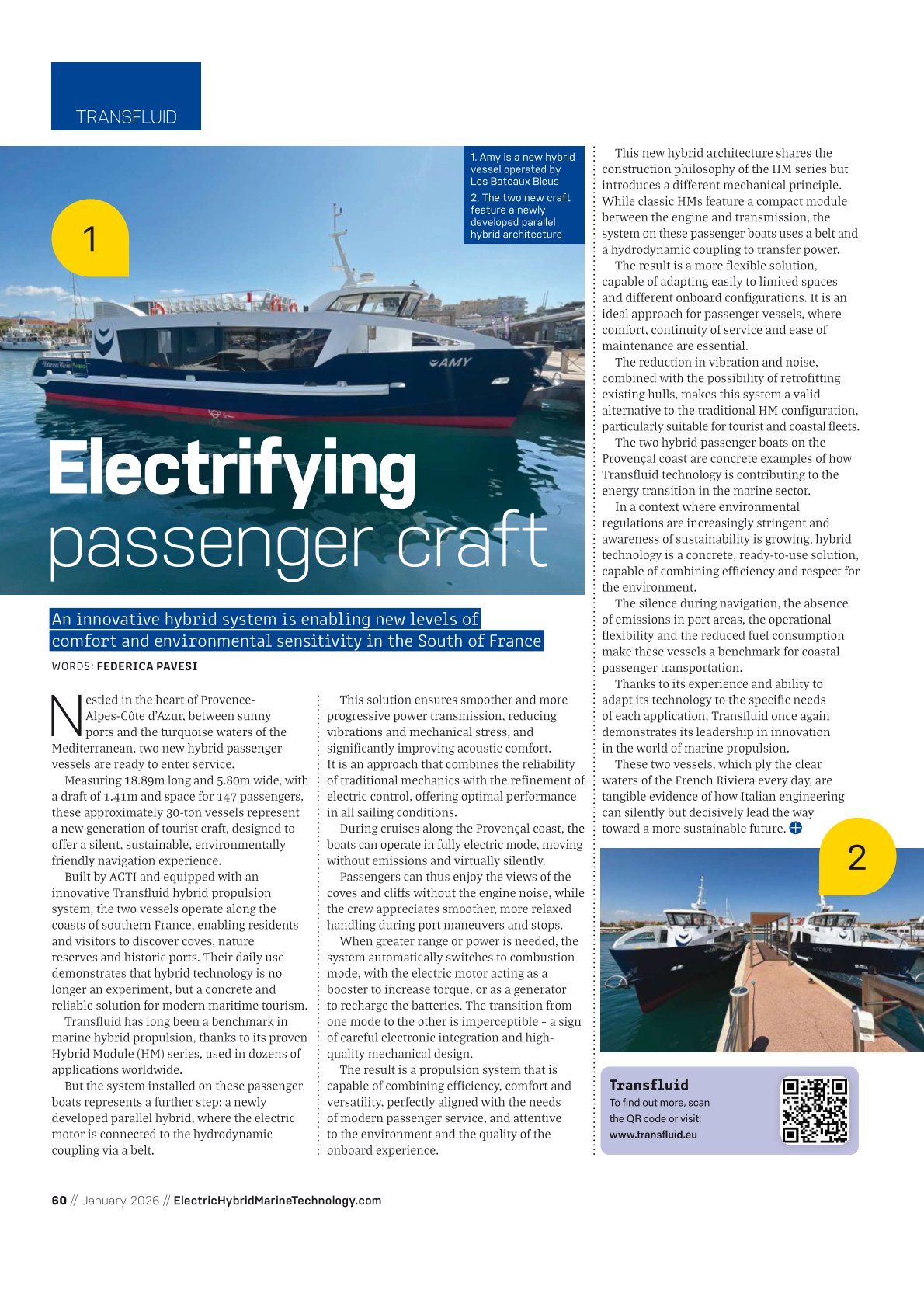
Mediterranean, two new hybrid passenger vessels are ready to enter service. Measuring 18.89m long and 5.80m wide, with a draft of 1.41m and space for 147 passengers, these approximately 30-ton vessels represent
a new generation of tourist craft, designed to offer a silent, sustainable, environmentally friendly navigation experience. Built by ACTI and equipped with an innovative Transfluid hybrid propulsion system, the two vessels operate along the coasts of southern France, enabling residents and visitors to discover coves, nature reserves and historic ports. Their daily use demonstrates that hybrid technology is no longer an experiment, but a concrete and reliable solution for modern maritime tourism.
Transfluid has long been a benchmark in marine hybrid propulsion, thanks to its proven Hybrid Module (HM) series, used in dozens of applications worldwide. But the system installed on these passenger boats represents a further step: a newly developed parallel hybrid, where the electric motor is connected to the hydrodynamic
coupling via a belt.
This solution ensures smoother and more progressive power transmission, reducing vibrations and mechanical stress, and significantly improving acoustic comfort. It is an approach that combines the reliability of traditional mechanics with the refinement of electric control, offering optimal performance in all sailing conditions.
During cruises along the Provençal coast, the boats can operate in fully electric mode, moving without emissions and virtually silently. Passengers can thus enjoy the views of the coves and cliffs without the engine noise, while
the crew appreciates smoother, more relaxed handling during port maneuvers and stops. When greater range or power is needed, the system automatically switches to combustion mode, with the electric motor acting as a
booster to increase torque, or as a generator to recharge the batteries. The transition from one mode to the other is imperceptible – a sign of careful electronic integration and highquality mechanical design.
The result is a propulsion system that is capable of combining efficiency, comfort and versatility, perfectly aligned with the needs of modern passenger service, and attentive to the environment and the quality of the onboard experience.